Tax-Aware Transitions for Concentrated Positions
For boutique RIAs and portfolio implementation teams managing concentrated appreciated stock positions under gains budgets, benchmark constraints, and implementation limits.
BasisLine Transitions supports a narrow private workflow for professional portfolio teams evaluating difficult taxable transitions. This is not a retail product or self-serve platform.
A focused workflow for a specific problem
Designed for boutique RIAs and portfolio implementation teams who manage taxable high-net-worth client accounts with concentrated appreciated positions.
Primary buyers
- Boutique RIAs with taxable HNW client books
- Portfolio implementation teams
- Small overlay or OCIO-style teams handling taxable transitions
- Specialized custom-indexing implementation teams
Best-fit characteristics
- Meaningful taxable assets under management
- Recurring concentrated-position transition pain
- Limited internal capacity for custom optimization workflows
- Existing workflow built around spreadsheets, heuristics, or generic rebalancers
- Need for better transition discipline under hard constraints
- Willingness to evaluate an external specialist workflow privately
Why these transitions become operationally difficult
Diversifying a concentrated appreciated position is not purely an allocation problem. It is a tax and implementation problem.
Operational burden matters as much as portfolio quality: when gains budgets, restricted names, exact holdings targets, and benchmark fit all need to hold at once, transitions often become messy and hard to defend.
What must be balanced
- Realized-gains budgets
- Benchmark or model alignment
- Exact holdings-count targets
- Restricted or do-not-sell positions
- Tax lots and loss opportunities
- Implementation simplicity
Typical friction
In practice, hard taxable transitions often become spreadsheet-driven tradeoffs or rule-based heuristic workflows that are difficult to tune when multiple constraints must hold at once. Tradeoffs get handled sequentially rather than jointly — which is where transitions become broader or messier than necessary.
What the private workflow evaluates
A focused analytical process for evaluating tax-aware transitions out of concentrated appreciated positions into benchmark-aware custom indexed portfolios.
Inputs
- Current holdings and weights
- Tax lots and cost basis
- Target benchmark or model
- Realized-gains budget
- Min and max position rules
- Restricted or legacy holdings
- Exact holdings-count target
Outputs
- Proposed trade list
- Realized-gains estimate
- Tracking-error proxy
- Sell turnover
- Sell ticket count
- Hard-constraint audit
- Baseline versus optimized comparison
Same gains budget, simpler implementation behavior
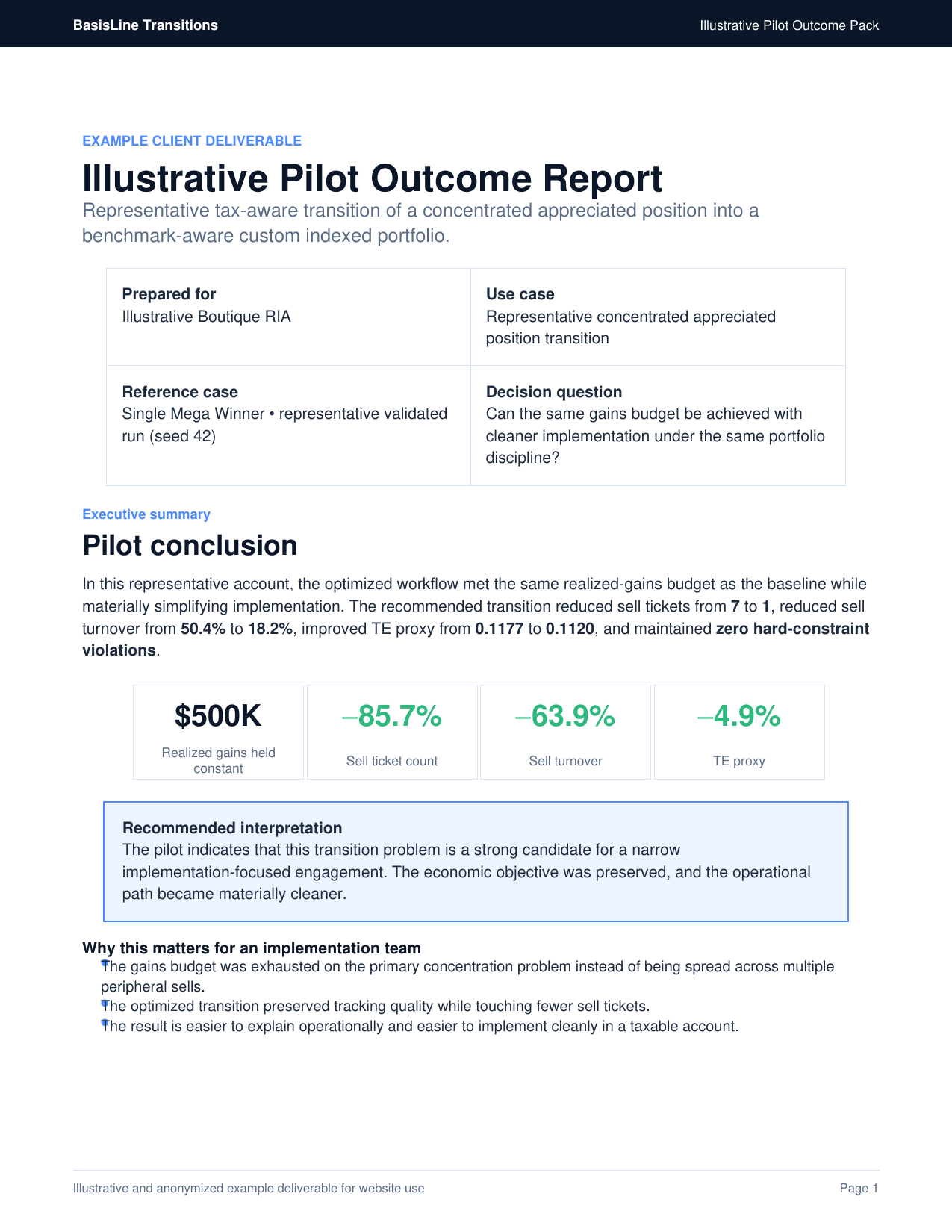
Illustrative concentrated-position account with a $500,000 realized-gains budget and benchmark-aware transition objective.
| Metric | Baseline | Workflow | Change |
|---|---|---|---|
| Realized Gains | $500,000 | $500,000 | — |
| TE Proxy | 0.1177 | 0.1120 | −4.9% |
| Sell Ticket Count | 7 | 1 | −85.7% |
| Sell Turnover | 50.4% | 18.2% | −63.9% |
| Hard Violations | 0 | 0 | — |
Illustrative concentrated-position account; anonymized representative case.
| Scenario | Baseline → Workflow tickets | Baseline → Workflow turnover |
|---|---|---|
| Single mega winner | 7 → 1 −85.7% | 50.4% → 18.2% −63.9% |
| Tight gains budget | 7 → 1 −85.7% | 33.3% → 12.8% −61.5% |
| Concentrated with losses | 9 → 1 −88.9% | 51.2% → 17.5% −65.8% |
| Two-name concentration | 8 → 2 −75.0% | 48.5% → 25.5% −47.4% |
- Results shown are representative validated scenarios, not a public product benchmark sheet.
- Baseline and optimized workflow are evaluated under the same gains budget and transition constraints.
- TE Proxy refers to the internal tracking-quality metric used for relative comparison across scenarios.
Interested in whether this applies to one of your transition cases?
Initial discussions can start with a representative or anonymized concentrated-position case before any deeper pilot work.
How a confidential pilot works
Kept intentionally narrow. One workflow, one concentrated-position problem, one private readout under NDA.
Pilot scope
- One narrow workflow only
- Concentrated appreciated position transitions into benchmark-aware custom indexed portfolios
- No hosted product required
- File-based inputs and report outputs are sufficient
- Private and NDA-based throughout
Pilot deliverables
- Review of current transition approach
- Representative case analysis
- Private optimization runs on sample or anonymized accounts
- Before/after comparison report
- Trade recommendations and hard-constraint audit
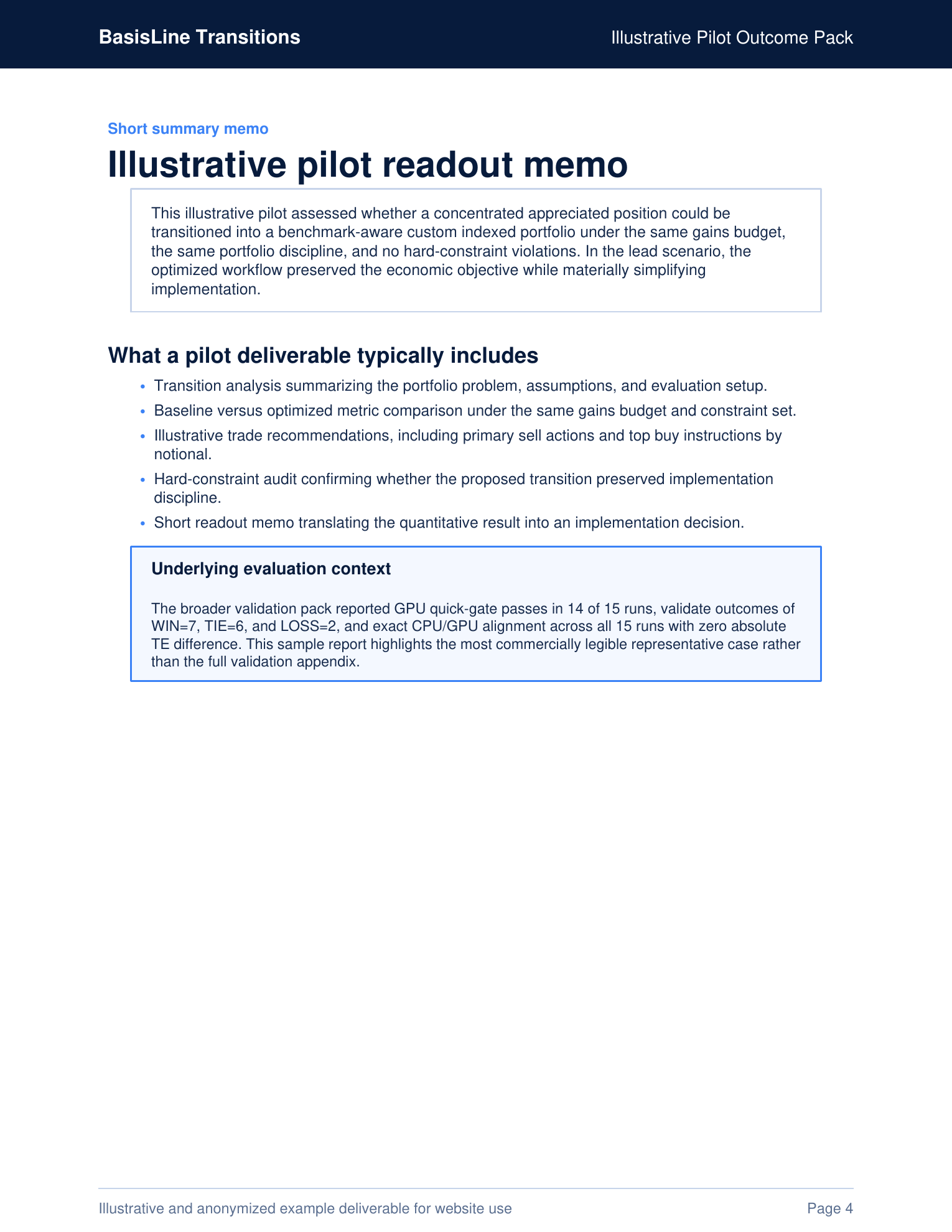
- Private pilot readout memo
Representative pilot outcome report — structure and depth you can expect from a completed pilot engagement.
Scope and structure
What this is
- Private analytical workflow
- Narrow pilot-first engagement
- B2B only
- Designed for professional portfolio teams
What this is not
- Not a retail product
- Not a self-serve advisor app
- Not a public direct-indexing platform
- Not an investment manager of record
Request a private discussion
Initial conversations are structured around representative or anonymized transition cases to determine whether the workflow is relevant for a specific concentrated-position problem.
A first conversation is intended to be narrow and practical: one concentrated-position transition problem, discussed in enough detail to evaluate mutual fit for a private pilot.
- Boutique RIA or implementation-team context
- Concentrated appreciated position with a defined transition challenge
- Interest in a private NDA-based evaluation
- Can complement existing implementation workflows without internal custom tooling
greg@basislinetransitions.com